Trust Is Infrastructure
On moving trust, not just information
The internet made moving information nearly free. It never made moving trust free.
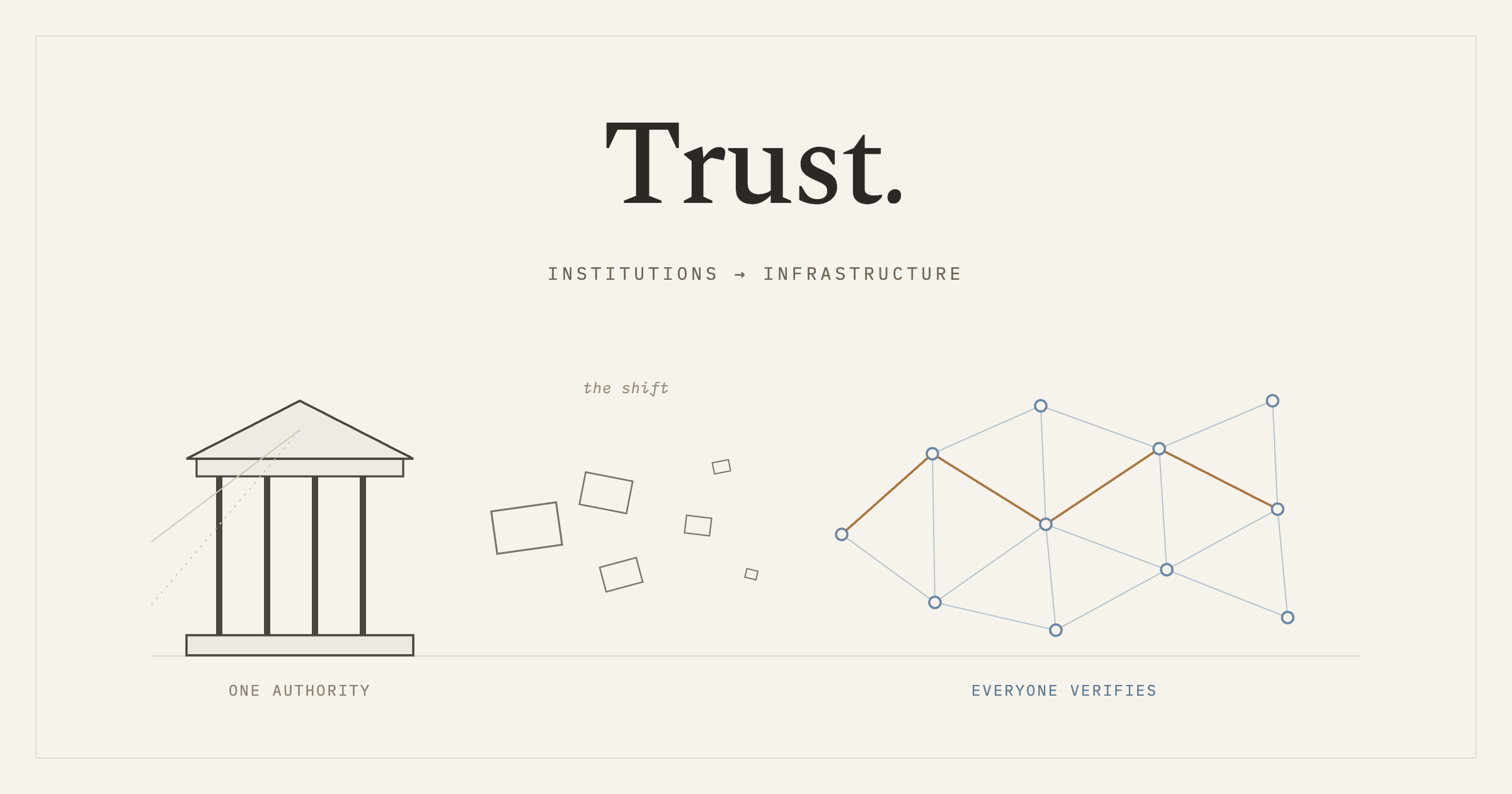
So we built institutions to do it. Escrow agents, clearing houses, registries, notaries, custodians, payment processors, credit bureaus, auditors. Every one of them exists because two parties could exchange information instantly but could not verify each other. We solved a coordination problem by hiring someone to stand in the middle.
Those intermediaries are not parasites. They are load-bearing, and they are usually good at the job. But they are the reason a wire takes days while an email takes milliseconds, and it is worth being precise about why.
Trust is not a feeling here
Trust, in this context, is not sentiment. It is a specific and boring question: can I act on this claim without independently confirming it?
Most of what we call friction is the cost of not being able to verify something.
Nearly every transaction reduces to a small set of these:
| Claim | The question underneath it |
|---|---|
| Identity | Are you who you say you are? |
| Ownership | Do you actually have the thing you are offering? |
| Contracts | Did we agree to the same terms, and will they be enforced? |
| Escrow | Who holds the asset while we both perform? |
| Payments | Did value actually move, and can it be reversed? |
Every one of these is currently answered by an institution attesting to it. You believe the title company. You believe the bank's balance. You believe the exchange holds what it claims. In each case you are not verifying the claim — you are trusting a party whose incentives you hope are aligned with yours, and accepting a delay while they check.
The delay is the interesting part. Settlement windows, holds, clearing periods, KYC re-checks: these are mostly not technical limits. They are the time it takes for an institution to become confident enough to be liable.
Verification instead of assumption
The shift I keep watching for is narrow: replacing assume, then reconcile with verify, then act.
Cryptography is unusually good at this. A signature proves a message came from a key holder without a registry. A hash proves a document hasn't changed without an archive. A proof can establish a fact without revealing what's behind it — that you're over eighteen without your birthdate, that you hold a balance without your statement.
These are not new. What is new is that they have become cheap enough, standardized enough, and fast enough to sit underneath ordinary systems rather than in a security appendix. When verification is cheaper than the institution that replaces it, the architecture changes.
That is what "trust is infrastructure" means. Not that institutions disappear — most won't, and many shouldn't — but that verification moves from a service you buy into a property the system has.
Deterministic and probabilistic
There are two technologies people currently attach the word "trust" to, and they are close to opposites. Keeping them straight matters more than any specific prediction.
Blockchains are deterministic. Given the same inputs, every participant computes the same result, and the value is precisely that there is no interpretation. Slow, expensive, rigid — and correct in a way you can check. Good for settlement, ownership records, and rules that must not bend.
AI is probabilistic. It generalizes, infers, and handles the ambiguity deterministic systems choke on. It is also confidently wrong sometimes, and its reasoning is not reproducible. Good for judgment, extraction, and the messy edges.
The failure mode is using each for the other's job. Deterministic systems make terrible judges; every attempt to encode nuanced human agreements into rigid code has discovered this expensively. Probabilistic systems make terrible ledgers; a system that is right 99% of the time is not a system of record, it is a lawsuit with good marketing.
Used together, though, the split is natural. Let the probabilistic layer interpret intent, assess the ambiguous, and decide what should happen. Let the deterministic layer record what did happen, in a form nobody has to be trusted about. Judgment on top, settlement underneath.
What this connects to
This is where open systems and verifiable rules stop being separate ideas.
Open systems matter because permissionless participation is what lets anyone build on the trust layer without asking. Verifiable rules matter because they are what make the trust layer worth building on — a settlement layer somebody can quietly rewrite is not infrastructure, it is a vendor.
Put them together and you get the actual thesis: when trust becomes verifiable, transactions that were previously uneconomic become ordinary. Not because the technology is impressive, but because the intermediary's fee, delay, and permission were the entire reason the transaction didn't happen.
Most of the friction in the economy is not physics. It is unverified claims, priced.
The internet moved information. The next layer moves trust — and the difference is that this time, nobody has to be believed.