
Launch Is a Confidence Threshold
A rollout model for regulated products
Over the past decade, I've seen the same pattern across fintech, payments, gaming, healthcare, marketplaces, and other operationally complex products.
Teams rarely fail because they cannot build software.
They fail because they mistake working software for an operable business.
In these environments, every stage should reduce uncertainty and earn permission for the next.
Launch isn't a date — it's a confidence threshold
One of the biggest mistakes I see is treating launch as a calendar event.
Launch is really the point where the team has earned enough evidence to expose the product to real users.
That evidence is not only technical. It includes legal, compliance, finance, operations, support, provider approvals, monitoring, and reconciliation.
Software is only one piece of the operating system. A product can be technically complete and still not be ready for real users, real money, or paid traffic.
That doesn't mean the team should move slowly. It means the team needs better gates — and the goal of each gate is to define the smallest safe step forward.
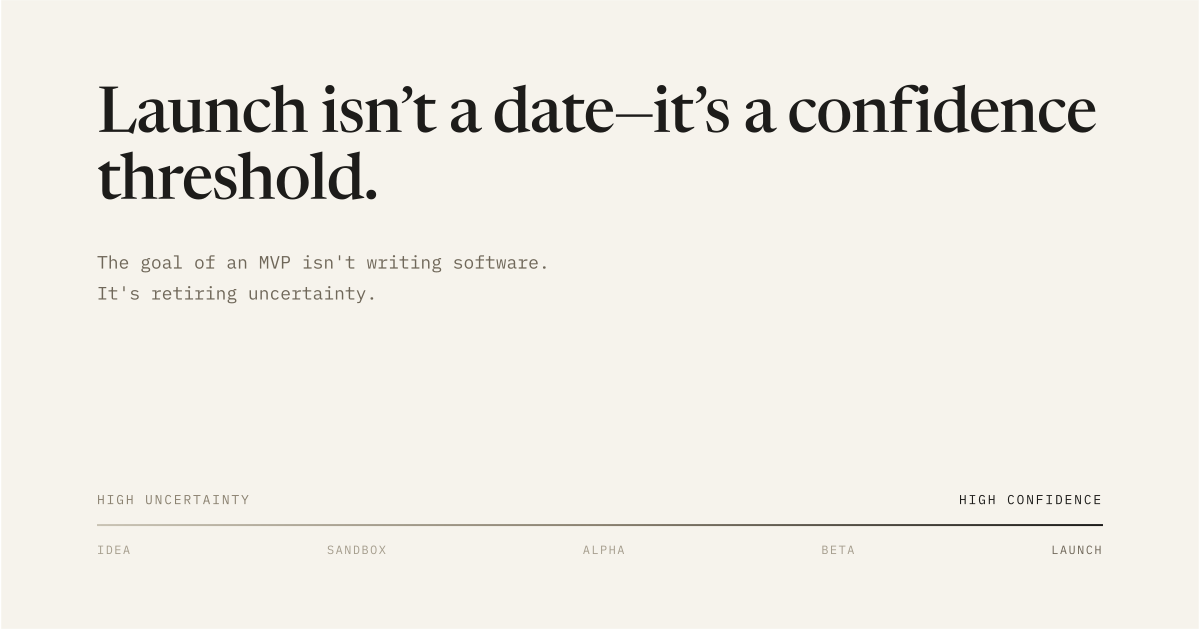
How do you know when enough confidence has been earned?
If launch is really a confidence threshold, the question becomes: how do you know when enough confidence has been earned?
That is where the rollout model helps.
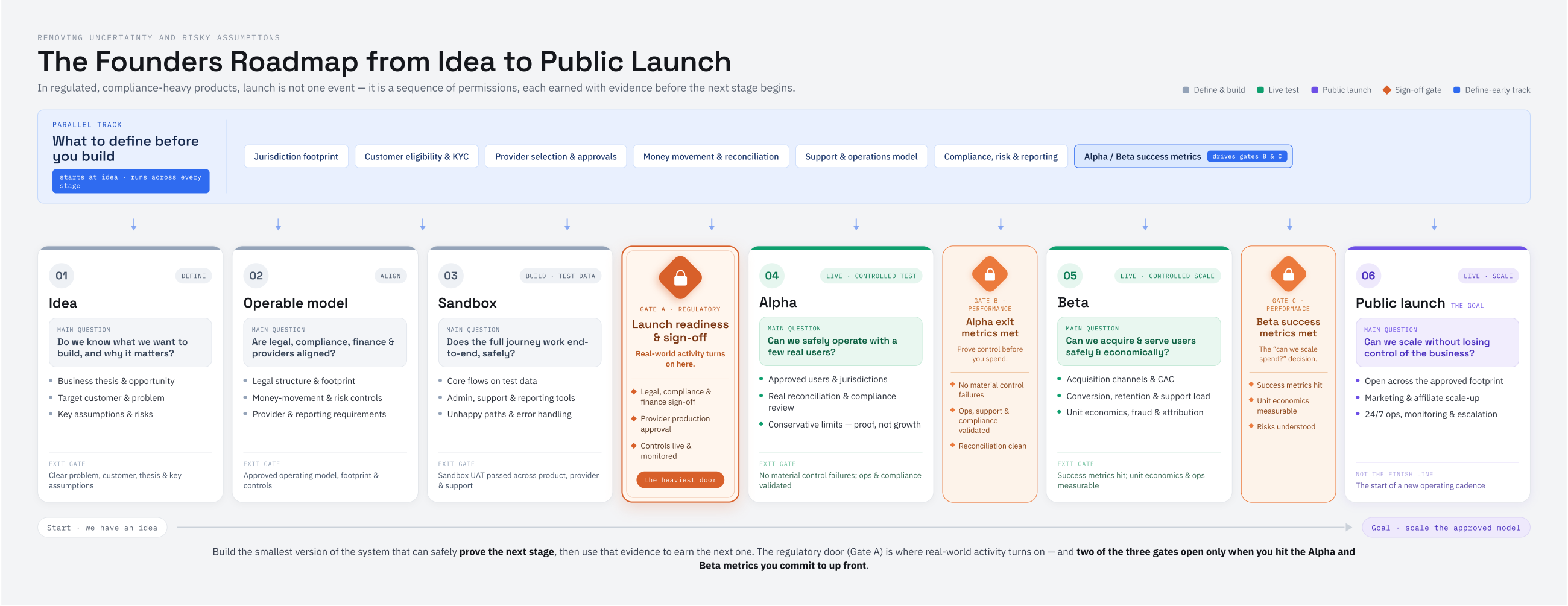
A simple maturity model for regulated rollouts
When I think about rolling out a product in a regulated or compliance-heavy environment, I like to separate the journey into six stages.
Each stage answers a different question.
Build the smallest version of the system that can safely prove the next stage.
1. Idea stage
"We know what we want to build."
There's a market thesis, a customer problem, a rough product shape, and some early conviction. That's useful — but at this stage the team has more assumptions than facts.
Key question: What are we trying to prove, and what could make this idea impossible, expensive, risky, or operationally painful?
Trap: jumping straight into product build before defining the operating model.
2. Operable model stage
"Legal, compliance, finance, and providers agree this can operate."
This is where the idea becomes real — not because the product is built, but because the team has defined the rules of the game: legal structure, eligibility, jurisdiction footprint, provider requirements, money movement, risk controls, support, data, reporting, and approvals. Bring in the people who will eventually say yes or no.
Key question: Are we aligned on how this business is allowed to work?
Trap: treating legal and compliance as late-stage reviewers. In a regulated product, they shape the product.
3. Sandbox stage
"The product works with test data."
The team proves the full journey works end-to-end in a controlled environment — registration, identity checks, eligibility, transaction simulation, provider routing, ledger behavior, support workflows, admin tools, reporting, reconciliation, blocked states, error handling, and audit logs.
Key question: Can the system perform the required journey without exposing the company or users to real risk?
Trap: testing only the happy path. What happens when a payment fails, a user is in a blocked jurisdiction, an identity check fails, a provider is down, or a transaction has to be reversed? Sandbox is where those answers should become visible.
4. Alpha stage
"The product works with real users, real controls, and limited real-world activity."
Alpha is a controlled live test, and the goal is proof, not growth. Approved users, approved jurisdictions, real provider connections, real support tickets, real monitoring, real reconciliation, real compliance review. Keep the limits conservative: small cohort, limited footprint, lower transaction limits, manual review where needed, daily cadence.
Key question: Can we safely operate this with real users before we invite the market in?
Trap: treating Alpha like a soft launch. Alpha should be boring on purpose.
5. Beta stage
"The business works with controlled acquisition, measurable economics, and real operational load."
Beta moves from "does it work?" to "can it scale?" — at controlled scale. Now you test acquisition channels, conversion, onboarding friction, customer quality, support volume, provider performance, fraud patterns, payment success, retention, unit economics, and attribution. Marketing gets more serious, but spend stays controlled, with clear stop-loss rules.
Key question: Can we acquire and serve users safely, measurably, and economically?
Trap: scaling spend before the team can explain the funnel. You should not scale what you cannot measure.
6. Public launch stage
"We are ready to scale spend, users, operations, and compliance monitoring."
Public launch isn't the first time the product meets the real world — it's the point where the team has enough confidence to open the system across the approved footprint. By now the team knows where it can operate, who's eligible, which controls are live, which providers are approved, how support, finance, and compliance handle issues, and how success is measured.
Key question: Are we ready to scale without losing control of the business?
Trap: thinking public launch is the finish line. It's the start of a new operating cadence.
The one-page version
| Stage | What it proves | Main question | Exit evidence |
|---|---|---|---|
| Idea | The opportunity is real and worth building | Do we understand what we want to build and why it matters? | Clear problem, target customer, business thesis, and key assumptions |
| Operable model | The business can work legally and operationally | Are legal, compliance, finance, product, engineering, and providers aligned? | Approved operating model, footprint, controls, and provider requirements |
| Sandbox | The full journey works end-to-end with test data | Does the full journey work end-to-end in a safe environment? | Sandbox UAT passed across product, provider, admin, support, and reporting flows |
| Alpha | The model holds up with real users | Can we safely operate with a small number of real users? | No material control failures; support, compliance, finance, and product flows validated |
| Beta | The model works at limited market scale | Can we acquire, convert, support, and reconcile users at limited scale? | Success metrics hit; risks understood; unit economics and operations are measurable |
| Public launch | The approved model can scale | Are we ready to scale traffic, spend, operations, and monitoring? | Growth, compliance, support, finance, and provider operations are ready for broader volume |
Decisions that should move earlier
The Alpha and Beta plan should not be created after the product is built. It should be defined while the product, providers, and operating model are still being shaped — because rollout strategy affects core decisions. Treat this as the practical checklist behind the framework.
Jurisdiction footprint
Where are users allowed? Where are they blocked? Does the product experience change by location? What happens when a user travels?
Customer eligibility
Who can register? Who can transact? Who needs identity verification? What happens when someone fails a check?
Provider selection
Which providers are required? What do they need to approve before production? What data do they send back? What happens if one of them fails?
Money movement and reconciliation
How does value move through the system? What records are the source of truth? How does finance close the day? How are exceptions handled?
Support and operations
What will users ask about? What can support answer directly? What needs escalation? What are the approved responses for sensitive issues?
Compliance and risk
What rules need to be enforced by the product? What needs manual review? What needs reporting? What would cause a user, campaign, provider, or jurisdiction to be paused?
Marketing and attribution
Which channels are allowed? What claims are approved? How are campaigns tagged? What metrics need to be trusted before spend increases?
My recommended path
For regulated rollouts, I like to work backward from public launch — not because the team needs every feature on day one, but because the team needs to understand what must be true before it can safely scale.
1. Define the operating model before finalizing the product
Do not separate product strategy from compliance, finance, and operations. The product is how the operating model gets enforced.
2. Define Alpha and Beta success metrics before launch
Alpha should prove control. Beta should prove market readiness. Those are different goals — do not mix them.
3. Treat providers as part of the product
Payments, identity, risk, data, support, and analytics providers are not external details. They are part of the customer experience and the operating system of the business.
4. Build reporting before scaling marketing
If the team cannot explain what happened yesterday, it is not ready to scale what happens tomorrow.
5. Keep early rollout intentionally constrained
Small does not mean weak. Small means observable. A constrained Alpha or Beta lets the team find issues while they are still manageable.
6. Scale only after the system proves it can absorb volume
Marketing can create pressure faster than the company can handle it. That pressure shows up in support, compliance, finance, fraud, provider limits, and engineering. The goal is not just to create demand — it's to create demand the company can safely serve.
Closing
Every stage should answer a different question.
Every stage should retire a different category of risk.
Every stage should earn permission for the next investment.
The goal isn't to eliminate uncertainty.
It's to reduce uncertainty faster than you increase investment.
Build evidence.
Not software.